
The 12 Best Competitor Price Tracking Software Tools for 2026
- Feb 7
- 20 min read
In today's fast-paced e-commerce landscape, pricing isn't just a number, it's a critical competitive advantage. Setting the right price can attract customers, maximize profits, and protect your brand's value. But with competitors adjusting their strategies in real-time, manual tracking is no longer a viable option. This is where dedicated competitor price tracking software becomes essential. These tools automate the collection and analysis of pricing data, giving you the intelligence to make strategic decisions quickly and confidently.
This guide cuts through the noise to analyze the 12 best solutions available today, from enterprise-grade platforms to DIY scraping infrastructure. We'll explore their core features, ideal use cases, and honest limitations to help you find the perfect fit for your business goals. When considering the diverse landscape of tools, it's beneficial to understand the broader context of choosing software for analyzing data in e-commerce, as competitor price tracking solutions are a specialized category within this field.
Our goal is to provide a comprehensive resource that moves beyond marketing claims. We dive into the practical aspects of each tool, including:
Key Differentiators: What makes each platform unique?
Ideal Use Cases: Who is this software built for?
Honest Limitations: Where might the tool fall short?
Each review includes screenshots and direct links, equipping you with everything needed to evaluate and select the best competitor price tracking software for your specific requirements. We'll cover everything from fully managed solutions like Prisync and DataWeave to the foundational scraping infrastructure offered by ScrapeUnblocker for teams building custom tools.
1. Price2Spy
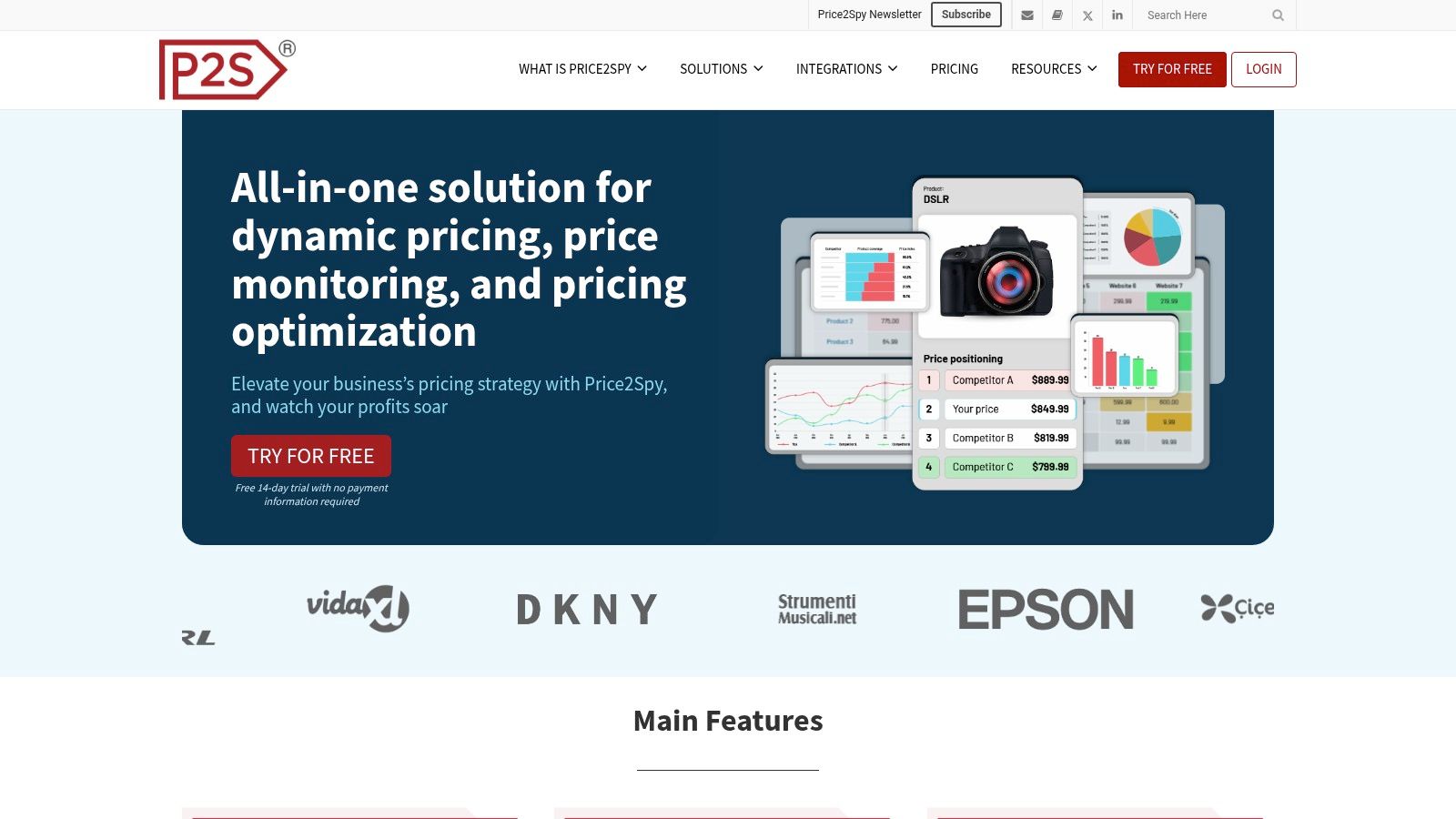
Price2Spy is a veteran in the competitor price tracking software space, offering a robust suite of tools for e-commerce stores, brands, and distributors. It provides both a self-service platform and enterprise-level solutions, making it accessible for businesses of various sizes. The platform’s core strength lies in its comprehensive data collection capabilities, handling everything from standard product pages to complex, login-protected B2B portals and major online marketplaces.
Its feature set is designed for action-oriented intelligence. Users can monitor competitor pricing, stock levels, and promotions with refresh frequencies up to eight times per day. The platform then translates this data into actionable insights through customizable alerts and over 25 different reporting options.
Key Features & Use Case
Price2Spy excels in automating the entire price monitoring and repricing workflow. A common use case is an online retailer using its dynamic repricing module to automatically adjust prices based on predefined rules, ensuring they remain competitive on platforms like Amazon without manual intervention.
Monitoring Frequency: Up to 8 checks per day.
Coverage: Handles standard websites, major marketplaces (Amazon, eBay, Walmart), and sites requiring a login.
Dynamic Repricing: An advanced module for rule-based price adjustments.
Integrations: Offers API access and native integrations for Shopify, Magento, BigCommerce, and WooCommerce.
Platform Analysis
Price2Spy stands out with its transparent, URL-based pricing and a generous 14-day free trial, allowing teams to fully evaluate its capabilities. While its self-service plans are clearly defined, the cost can escalate as the number of tracked URLs and the required check frequency increase. For large-scale operations, a custom enterprise plan is often necessary.
Pros: Handles technically challenging targets like bot-protected and login-gated sites; clear plan structure for small to mid-sized businesses.
Cons: Pricing can become a significant factor at scale; advanced features and higher frequencies are reserved for premium tiers.
Website: https://www.price2spy.com
2. Price2Spy
Price2Spy is a veteran in the competitor price tracking software space, offering a robust suite of tools for e-commerce stores, brands, and distributors. It provides both a self-service platform and enterprise-level solutions, making it accessible for businesses of various sizes. The platform’s core strength lies in its comprehensive data collection capabilities, handling everything from standard product pages to complex, login-protected B2B portals and major online marketplaces.
Its feature set is designed for action-oriented intelligence. Users can monitor competitor pricing, stock levels, and promotions with refresh frequencies up to eight times per day. The platform then translates this data into actionable insights through customizable alerts and over 25 different reporting options.
Key Features & Use Case
Price2Spy excels in automating the entire price monitoring and repricing workflow. A common use case is an online retailer using its dynamic repricing module to automatically adjust prices based on predefined rules, ensuring they remain competitive on platforms like Amazon without manual intervention.
Monitoring Frequency: Up to 8 checks per day.
Coverage: Handles standard websites, major marketplaces (Amazon, eBay, Walmart), and sites requiring a login.
Dynamic Repricing: An advanced module for rule-based price adjustments.
Integrations: Offers API access and native integrations for Shopify, Magento, BigCommerce, and WooCommerce.
Platform Analysis
Price2Spy stands out with its transparent, URL-based pricing and a generous 14-day free trial, allowing teams to fully evaluate its capabilities. While its self-service plans are clearly defined, the cost can escalate as the number of tracked URLs and the required check frequency increase. For large-scale operations, a custom enterprise plan is often necessary.
Pros: Handles technically challenging targets like bot-protected and login-gated sites; clear plan structure for small to mid-sized businesses.
Cons: Pricing can become a significant factor at scale; advanced features and higher frequencies are reserved for premium tiers.
Website: https://www.price2spy.com
3. Prisync
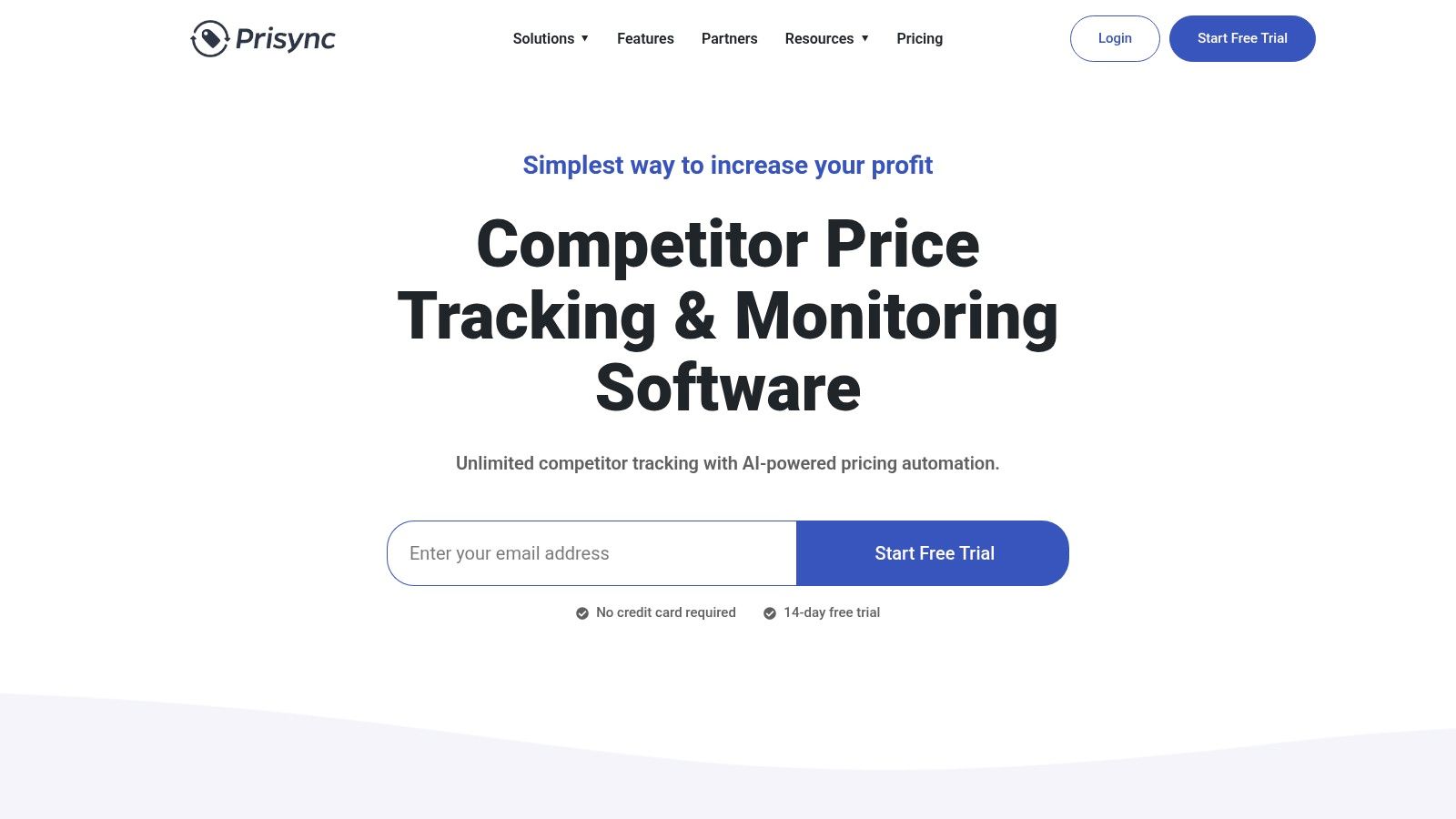
Prisync is a competitor price tracking software designed primarily for small to mid-sized e-commerce businesses. It offers a clean interface and a straightforward approach to competitor price monitoring, MAP (Minimum Advertised Price) tracking, and dynamic repricing. The platform is particularly popular among Shopify merchants due to its dedicated app and seamless integration. Prisync gives users flexibility with different monitoring modes, including URL-based, channel-based, and a hybrid model.
Its core value lies in making powerful pricing intelligence accessible. Users can track an unlimited number of competitors on core plans, receiving price updates multiple times per day. The system also includes a dynamic pricing engine to automate price adjustments based on market conditions and predefined rules, helping stores stay competitive without constant manual oversight.
Key Features & Use Case
Prisync is ideal for a Shopify store owner who needs a set-it-and-forget-it solution to monitor key competitors and automatically adjust prices to maximize sales. For example, a user can set a rule to always be 5% cheaper than the lowest-priced competitor but never drop below a specific margin. The platform’s MAP monitoring is also a key use case for brands wanting to protect their value by receiving instant notifications when a reseller violates pricing policies.
Monitoring Frequency: Up to 3 checks per day (URL-based) and daily checks (channel-based).
Coverage: Tracks competitor websites, marketplaces, and product variants.
Dynamic Repricing: Built-in engine for automated, rule-based price adjustments.
Integrations: Strong Shopify integration with a dedicated app, plus Magento and API access.
Platform Analysis
Prisync stands out with its transparent pricing and a no-credit-card-required 14-day free trial, which lowers the barrier to entry for smaller businesses. Its focus on the Shopify ecosystem makes it a go-to choice for merchants on that platform. However, one notable drawback is that API access, which is crucial for custom integrations, comes at an additional 20% surcharge on the subscription fee. This is a critical consideration for businesses that rely on their own systems to handle data, which often involves understanding the complexities of how to scrape a website without getting blocked.
Pros: Clear, predictable pricing plans and a generous free trial; excellent integration and specific plan for Shopify users.
Cons: API access requires a significant surcharge; some advanced features like MAP monitoring are limited to higher-tier plans.
Website: https://prisync.com
4. Wiser Solutions
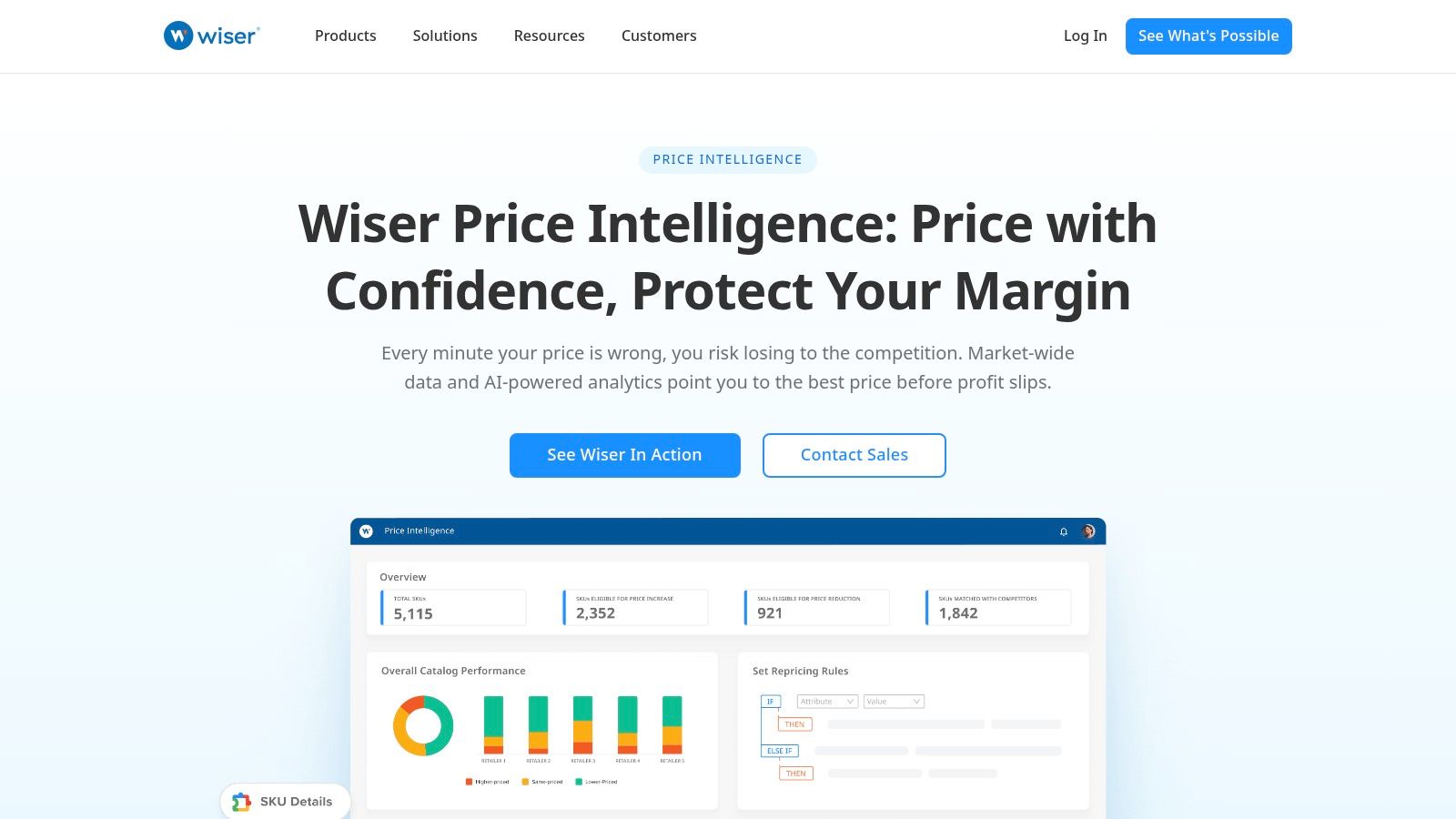
Wiser Solutions offers an enterprise-grade price intelligence and execution suite designed for large organizations that require high-frequency data and robust governance. It moves beyond simple monitoring by integrating promo tracking, stock-out visibility, and rule-based price recommendations into a single platform. The service is built for scale, capable of tracking millions of product prices with near real-time updates.
This platform is engineered for large teams that need granular control and proven reliability. Its infrastructure supports updates as frequently as every 15 minutes, feeding live dashboards and a dedicated API. This makes it a powerful piece of competitor price tracking software for retailers and brands whose pricing strategies depend on immediate market feedback and rapid execution.
Key Features & Use Case
Wiser Solutions excels in providing a holistic view of the competitive landscape for large-scale operations. A typical use case involves a national retailer using the platform to monitor thousands of SKUs across multiple online competitors, receiving instant alerts on price drops, and using the Live Prices API to power their internal repricing engine while adhering to corporate governance rules.
Monitoring Frequency: Updates as often as every 15 minutes.
Coverage: Tracks millions of price signals across e-commerce sites and marketplaces.
Enterprise Controls: Includes SSO and role-based access for secure team management.
Integrations: Offers a Live Prices API and a Chrome extension for in-context spot checks.
Platform Analysis
Wiser stands out for its proven ability to handle massive data volumes and its focus on enterprise-level security and controls. The platform is ideal for organizations where data accuracy, speed, and internal governance are paramount. However, its sophisticated offering and sales-led onboarding process mean there is no public pricing or self-service trial available.
Pros: Proven to operate at a massive scale with enterprise references; strong security and governance features suitable for large organizations.
Cons: No public pricing requires engaging with a sales team; the feature set may be overly complex and expensive for small to mid-sized businesses.
5. DataWeave
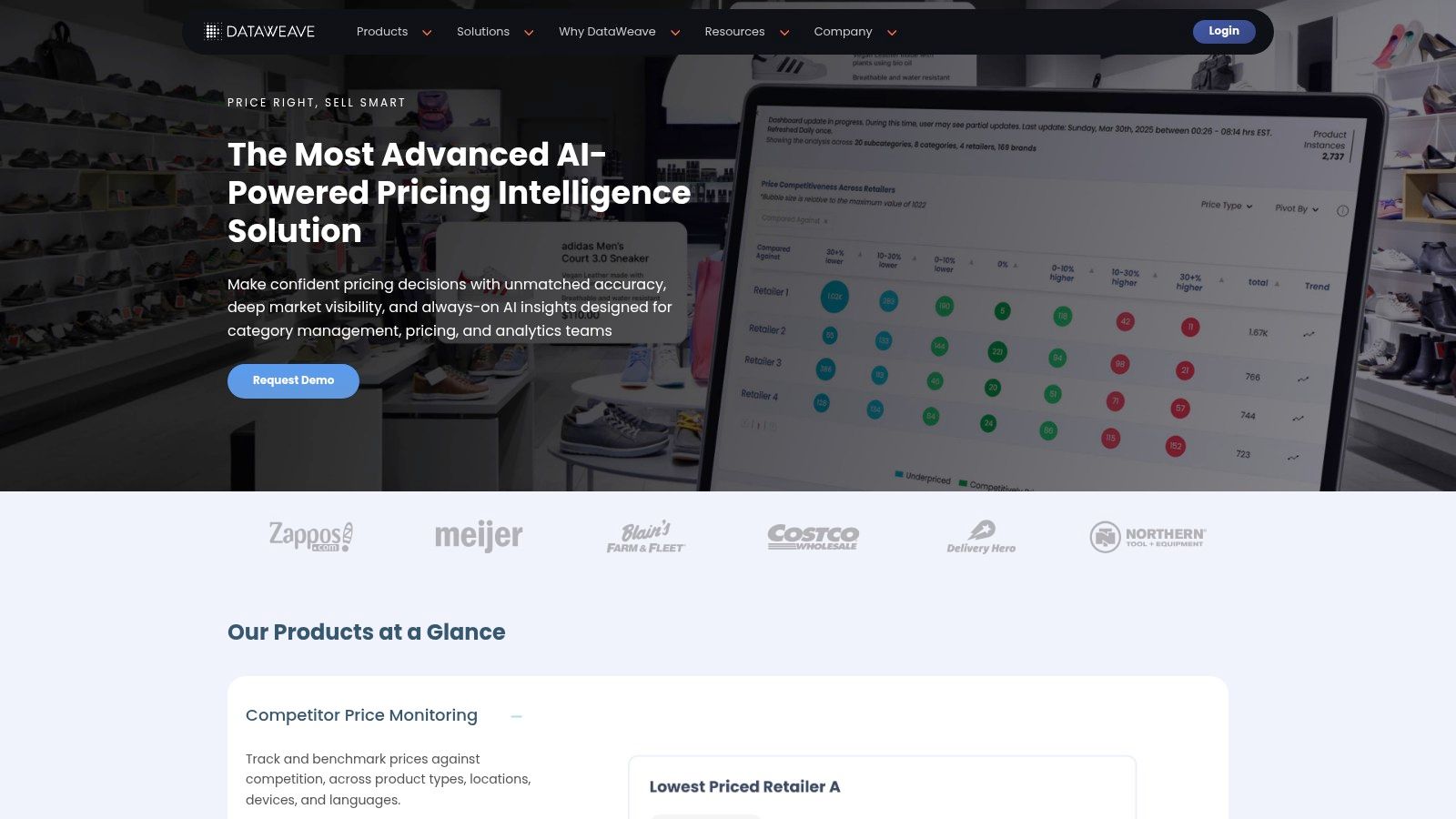
DataWeave positions itself as an enterprise-grade competitive intelligence platform, leveraging AI to deliver pricing, promotion, and assortment data to large retailers and brands. It moves beyond simple price monitoring to offer a suite of analytical tools, including pricing optimization and advanced product matching. The platform is designed for businesses needing broad market coverage across various locations, devices, and languages, providing a holistic view of the competitive landscape.
Its core value is in its AI-powered data aggregation and analytics, which helps businesses make strategic decisions rather than just reactive price changes. DataWeave’s infrastructure is built to handle large-scale data feeds, making it a suitable choice for global brands that require robust and reliable intelligence.
Key Features & Use Case
DataWeave is ideal for enterprise teams that need to integrate high-quality competitive data directly into their business intelligence workflows. A common use case involves a large CPG brand using DataWeave to monitor how its products are priced and presented across hundreds of online retailers, identifying unauthorized sellers and ensuring MAP compliance. This approach is more strategic than simple price adjustments on a single platform.
Advanced Product Matching: Uses AI to accurately link identical and similar products across different websites.
Pricing Modeling: Provides tools and analytics to model the impact of pricing changes before implementation.
Broad Market Coverage: Tracks data across different geographies, languages, and device types.
Enterprise SLAs: Offers service-level agreements that guarantee data quality and delivery for enterprise clients.
Platform Analysis
DataWeave is clearly targeted at the enterprise segment, which is reflected in its sales-led engagement model. There is no public pricing or self-service trial; access requires a demo and custom quote. This model ensures that clients are a good fit for their comprehensive, and likely expensive, service. While this provides a high-touch experience, it creates a barrier for small or mid-sized businesses looking for a straightforward competitor price tracking software solution.
Pros: Powerful AI-driven product matching and assortment analysis; offers enterprise-grade SLAs and support.
Cons: Opaque pricing model requires a sales consultation; not suited for small businesses or those needing a self-service tool.
6. Intelligence Node
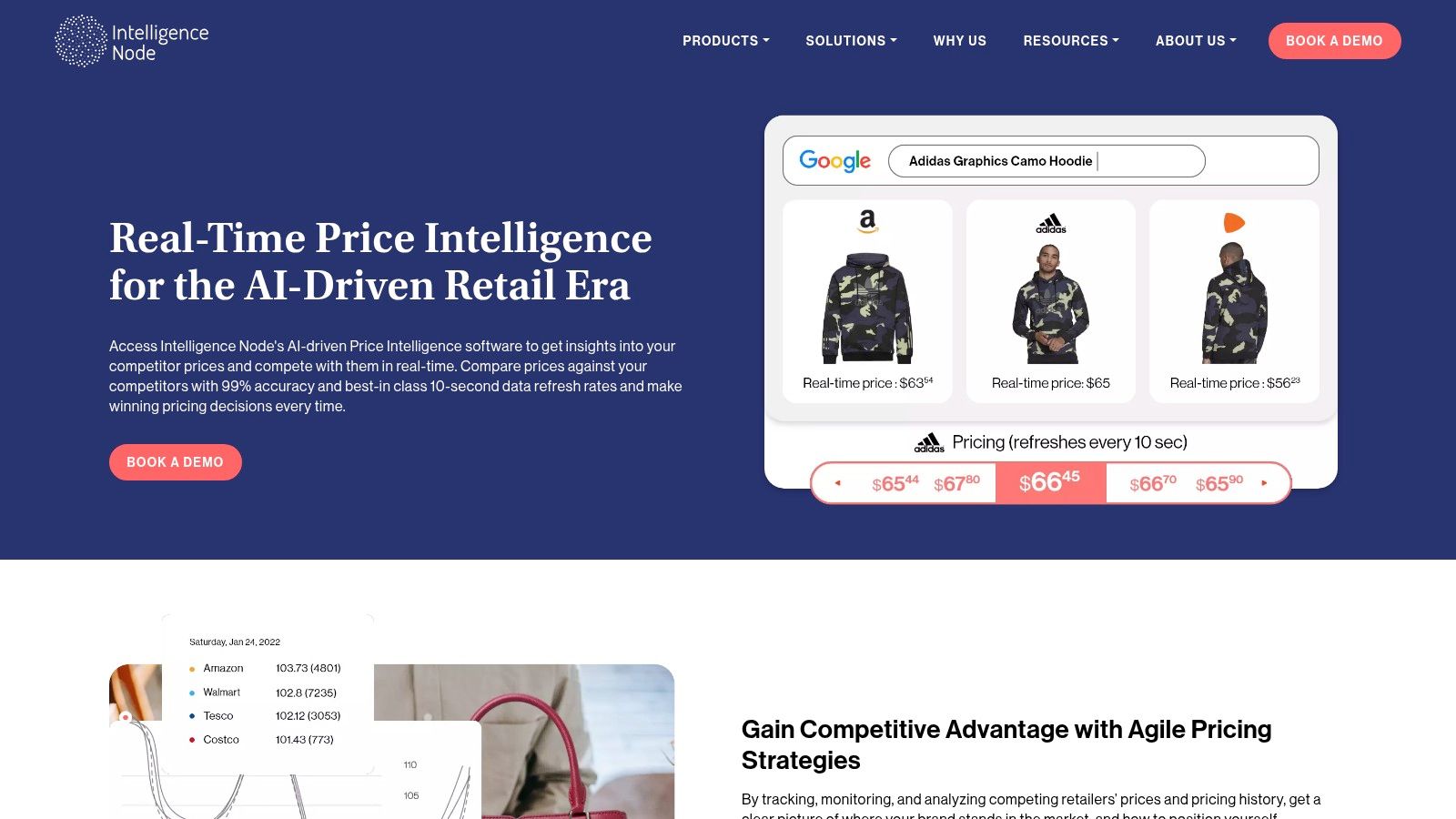
Intelligence Node is an enterprise-grade competitor price tracking software designed for large retailers and brands demanding high-frequency, highly accurate data. It sets itself apart with patented product matching technology and a Service Level Agreement (SLA) backing its 99% accuracy claim. The platform is built for real-time intelligence, providing clients with rapid updates on competitor prices, stock levels, and promotions at a global scale.
Its architecture is geared toward delivering fresh, reliable data through plug-and-play APIs and comprehensive dashboards. This allows businesses to make critical pricing and assortment decisions based on data they can formally trust, moving beyond standard monitoring to true strategic intelligence.
Key Features & Use Case
Intelligence Node excels in scenarios where data integrity and speed are non-negotiable. A global electronics brand could use the platform to enforce its Minimum Advertised Price (MAP) policy, leveraging near-instant alerts to identify violations across thousands of online retailers and marketplaces, backed by an SLA that guarantees data accuracy for compliance actions.
Monitoring Frequency: Extremely high, with refresh rates as low as every 10 seconds for certain products.
Coverage: Global crawling capabilities across standard e-commerce sites and major marketplaces.
Patented Product Matching: Delivers a 99% accuracy SLA for linking identical products across different sellers.
Integrations: Primarily offers robust, plug-and-play APIs for seamless integration into existing business intelligence systems.
Platform Analysis
The platform's primary strength lies in its formal guarantees. The SLAs on data freshness and matching accuracy provide a level of confidence that is rare in the industry, making it a powerful tool for high-stakes retail operations. However, this enterprise focus means it is not accessible for small or mid-sized businesses. Pricing is custom and reflects its premium, high-touch service model.
Pros: Industry-leading SLAs for data accuracy and freshness; patented product matching technology minimizes errors.
Cons: Enterprise-only focus with high-cost custom pricing; not suitable for SMBs or those without significant budgets.
7. Competera
Competera positions itself as an AI-driven pricing optimization platform, moving beyond simple data collection to offer actionable recommendations. It is designed for enterprise-level retailers and brands that need a unified solution for both gathering competitive intelligence and executing pricing strategies. The platform combines real-time market data with sophisticated recommendation and simulation tools, allowing teams to manage data and make AI-supported decisions within a single workspace.
Its core value proposition is the integration of high-quality data with predictive analytics. Competera provides AI-powered product matching with service-level agreement (SLA) guarantees, ensuring data accuracy. This data then feeds into its rule-based or AI-driven pricing engines to generate optimized price recommendations across various sales channels.

Key Features & Use Case
Competera is ideal for large retail operations looking to automate pricing decisions based on predicted outcomes. A common use case involves a multi-channel retailer using the platform's "what-if" simulation tools to forecast the impact of price changes on KPIs like revenue and profit margins before deploying them live, minimizing risk and maximizing performance.
Product Matching: AI-powered matching with guaranteed accuracy through SLAs.
Price Optimization: Rule-based and AI-driven price recommendations.
Predictive Analytics: "What-if" simulations to forecast the impact of pricing strategies.
Data Delivery: Real-time market data accessible via API, with optional SLAs.
Platform Analysis
Competera stands out by bundling data collection and pricing optimization into a comprehensive platform, backed by strong SLAs. This makes it a powerful tool for teams that want a single source of truth for competitive insights and pricing execution. However, its enterprise focus means there is no public pricing; access requires engaging with their sales team for a custom quote, which can be a barrier for smaller businesses.
Pros: Combines data collection and AI optimization in one platform; offers strong SLAs and a "pay-for-delivered-data" model.
Cons: Enterprise-centric sales process with no transparent pricing; the total cost is only available after a demo and consultation.
Website: https://competera.ai/pricing
8. Omnia Retail
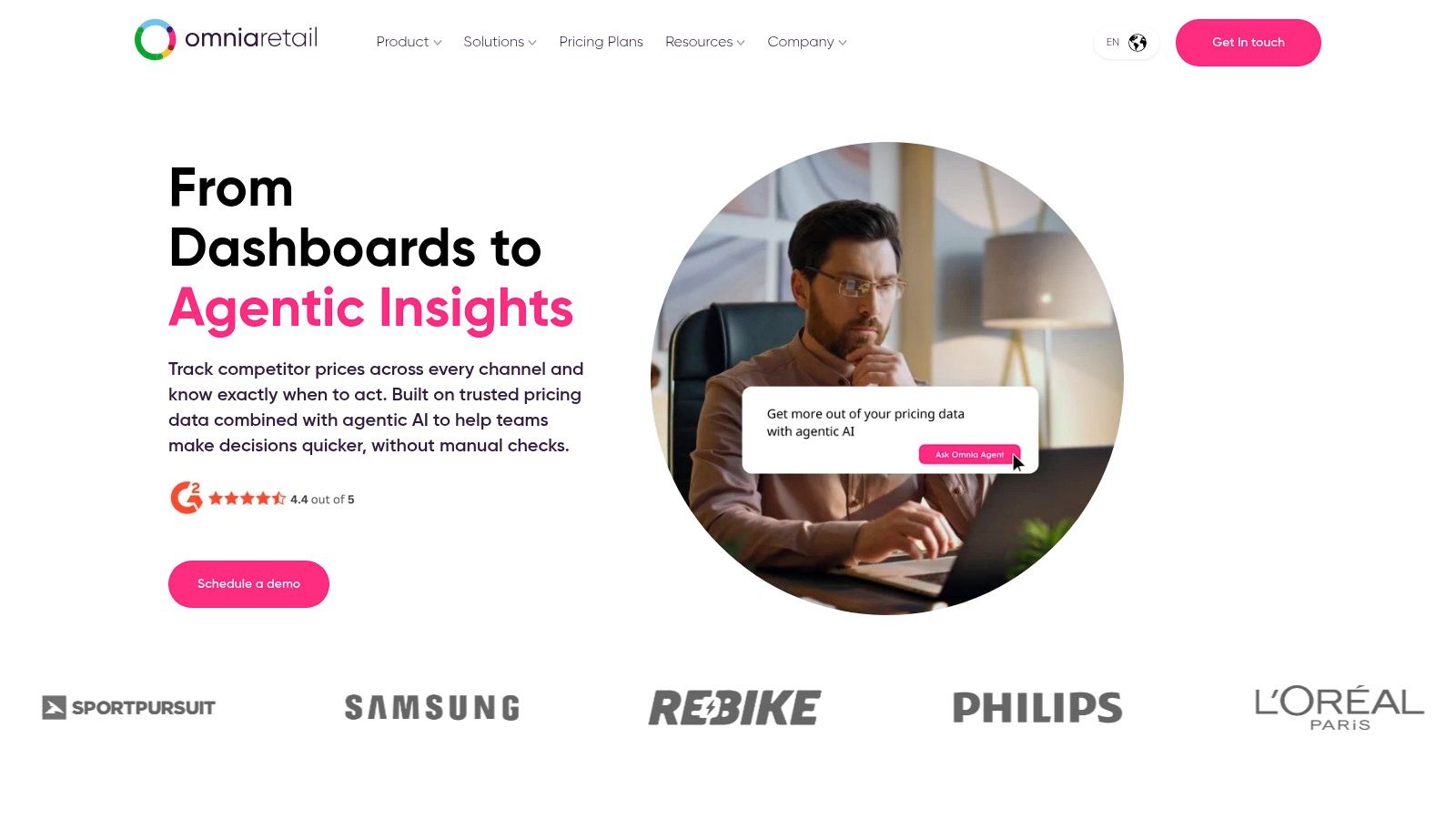
Omnia Retail is an enterprise-grade competitor price tracking software designed for large retailers and brands that require sophisticated pricing automation. It moves beyond simple monitoring by integrating data collection directly with dynamic pricing strategy execution. The platform is built to handle complex retail environments, monitoring competitors across any domain, including direct-to-consumer sites, niche stores, major marketplaces, and comparison shopping engines.
Its core value proposition is turning raw pricing data into automated, strategy-driven actions. The platform provides flexible crawl scheduling and advanced filtering to ensure data accuracy. This data then feeds into a "Pricing Strategy Tree," allowing businesses to build and automate complex pricing rules based on market position, stock levels, and profit margins.
Key Features & Use Case
Omnia Retail is ideal for large e-commerce businesses managing extensive product catalogs across multiple channels. A primary use case involves a retailer using the Pricing Strategy Tree to automatically lower prices on key products to match a specific competitor, while simultaneously increasing prices on less price-sensitive items to protect margins, all without manual input.
Monitoring Frequency: Flexible crawl schedules tailored to client needs.
Coverage: Monitors any domain, including marketplaces (e.g., Amazon, Google Shopping) and comparison engines.
Pricing Strategy Tree: A visual, rule-based engine for creating and automating pricing strategies.
Integrations: Offers integrations with major e-commerce platforms like Shopify and Magento, plus API access.
Platform Analysis
Omnia Retail excels in its ability to connect data collection directly to pricing execution, making it a powerful tool for automation at scale. Its strength lies in handling complex, multi-domain monitoring requirements for enterprise clients. However, its sophisticated nature and enterprise focus mean it lacks transparent pricing; access is available only through a demo and a sales-led onboarding process.
Pros: Excellent for complex, multi-domain monitoring; directly links data to automated pricing actions.
Cons: Pricing is available by demo only; heavily skewed toward mid-market and enterprise clients, making it less accessible for smaller businesses.
9. Minderest
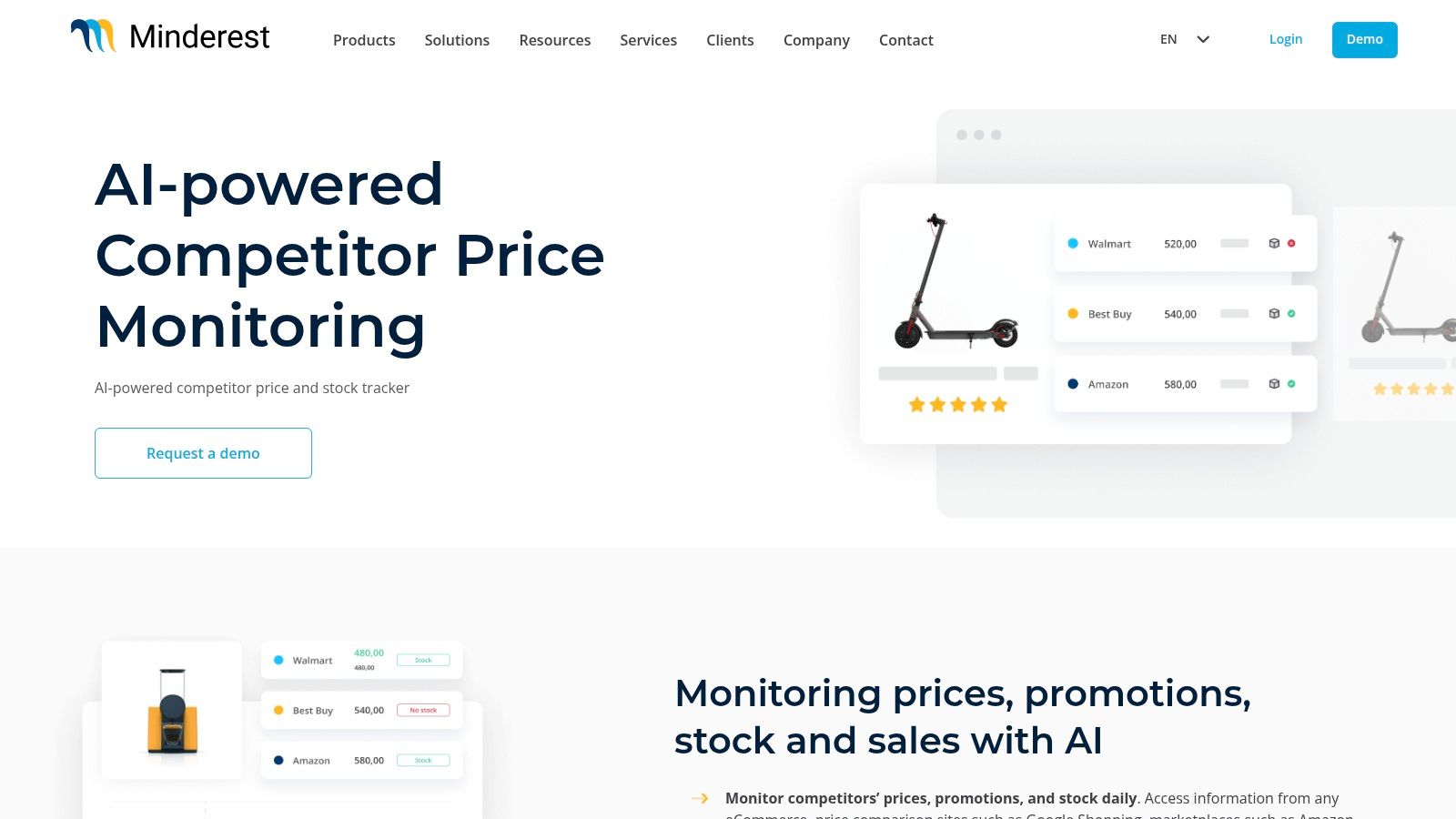
Minderest positions itself as an AI-powered competitor price tracking software, serving both retailers and brands with a strong focus on data quality and compliance. The platform monitors prices, stock levels, and promotions across a wide range of channels, including standard e-commerce sites, major marketplaces like Amazon, comparison shopping engines (CSEs), and B2B portals. Its use of AI for product matching is a key differentiator, allowing it to identify equivalents even without standard identifiers like EANs.
A standout feature is its robust Minimum Advertised Price (MAP) enforcement module, which provides screenshot evidence to support compliance claims. This makes it particularly valuable for brands needing to protect their pricing integrity across a distributed retail network.
Key Features & Use Case
Minderest is ideal for brands that need to meticulously enforce MAP policies. A typical use case involves a brand manager using the platform to automatically detect violations, gathering time-stamped screenshot evidence of a retailer's non-compliant pricing. This evidence can then be used to formally address the issue, streamlining a historically manual process.
AI-Powered Matching: Identifies exact, similar, and private-label product equivalents.
MAP Enforcement: Includes screenshot evidence for compliance verification.
Broad Coverage: Tracks e-commerce, marketplaces, CSEs, and B2B portals daily.
Integrations: Offers API access and BI tool integrations with unlimited historical data.
Platform Analysis
Minderest’s strength lies in its comprehensive data and evidence-gathering capabilities, making it a powerful tool for brands focused on market integrity and data-driven strategy. The platform's commitment to unlimited historical data access is a significant benefit for long-term trend analysis. However, its enterprise focus means potential users cannot simply sign up online.
Pros: Excellent for MAP enforcement with verifiable evidence; powerful AI product matching reduces manual work.
Cons: Pricing is not public and requires a sales demo; no self-service option for immediate signup.
10. Skuuudle
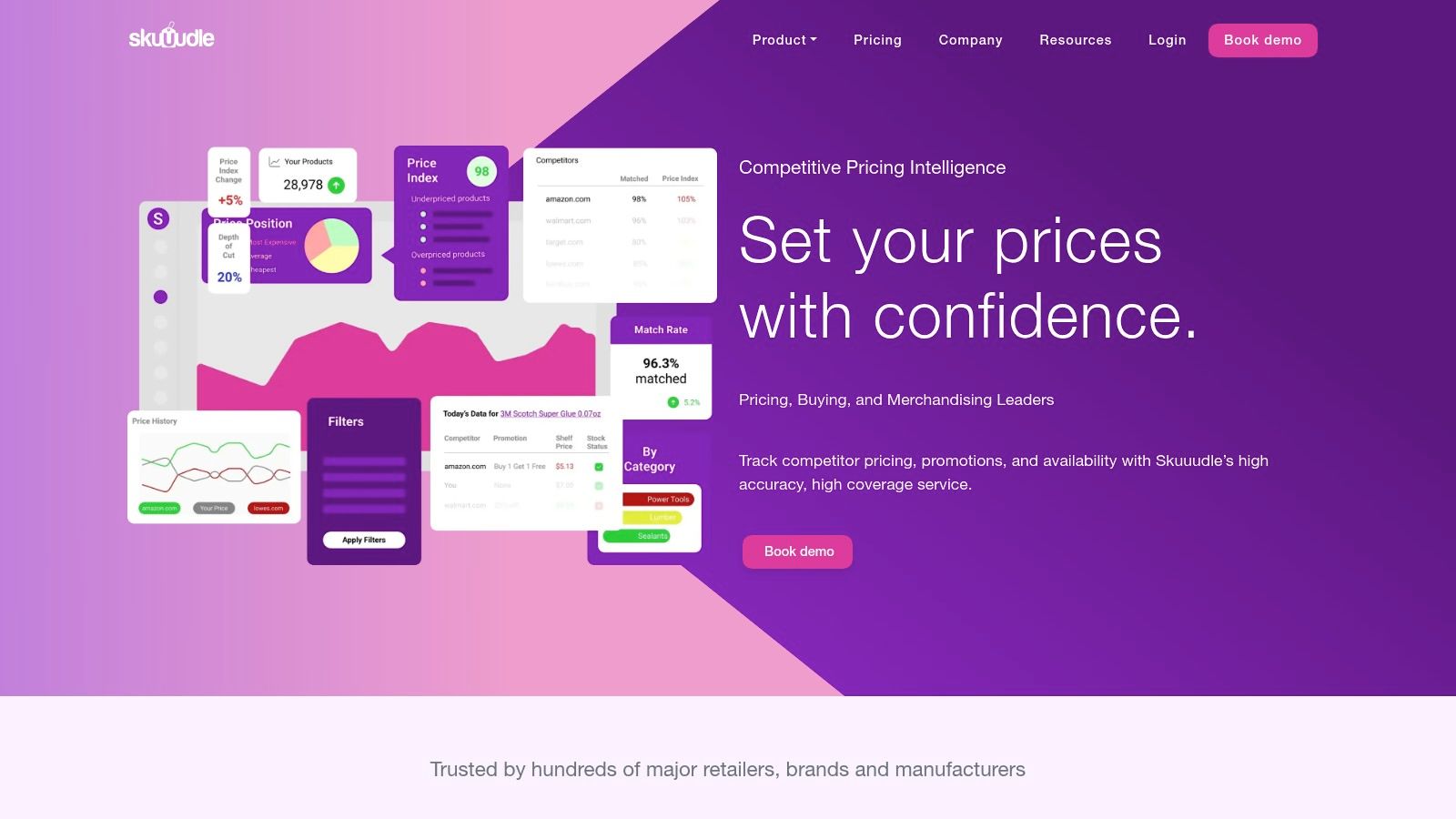
Skuuudle positions itself as a full-service competitive intelligence partner, prioritizing data accuracy and quality control above all else. This platform is less of a self-service tool and more of a managed engagement, making it ideal for enterprise-level buyers who require signed-off reports and transparent budget expectations. They handle the entire workflow, from complex product matching (including private labels) to scraping prices, promotions, stock levels, and shipping fees across any website or region.
The core of their offering is a guarantee of quality. Skuuudle delivers cleansed and validated data through customized dashboards and KPI reports tailored for pricing and buying teams. This high-touch approach ensures that the insights are not just raw data points but actionable intelligence backed by a continuous quality assurance process.
Key Features & Use Case
Skuuudle is best suited for large retailers or brands that need a reliable, hands-off solution for their competitor price tracking software needs. A common use case involves a multi-national retailer outsourcing its entire price intelligence function to Skuuudle, receiving daily or weekly reports on competitor positioning with a formal quality control sign-off, freeing up internal teams to focus on strategy rather than data collection.
Managed Service: End-to-end product matching, data scraping, and quality assurance.
Data Scope: Captures price, promotions, stock, shipping fees, reviews, and more.
Reporting: Custom dashboards and KPI reports designed for pricing and buying teams.
Transparency: Offers clear budget expectations and service levels, particularly for US, UK, and CA enterprise clients.
Platform Analysis
Skuuudle’s main strength is its unwavering focus on data accuracy, symbolized by its named QC sign-offs. This makes it a dependable choice for organizations where pricing decisions carry significant financial impact. The trade-off for this managed, high-quality service is the lack of an instant-access, self-service UI that some teams might prefer. It's built for strategic partnerships rather than quick, DIY data pulls.
Pros: Exceptional data accuracy with a robust QA process; transparent pricing models for enterprise buyers.
Cons: The managed-service model is less suitable for teams needing immediate, self-service access; higher-touch engagements may not fit all workflows.
Website: https://skuuudle.com
11. BlackCurve
BlackCurve is a competitor price tracking software designed for e-commerce merchants, with a strong focus on native platform integration and dynamic pricing. It offers a straightforward solution for businesses using popular platforms like Shopify and Magento, providing tools for both competitor discovery and automated price adjustments. The system monitors competitors through direct site scraping and Google Shopping, ensuring merchants have a clear view of the market landscape.
The platform's main appeal is its accessibility for merchants on mainstream e-commerce platforms, offering a dedicated Shopify app for quick and easy onboarding. BlackCurve's dynamic pricing engine allows users to set custom rules and safeguards, empowering them to react to market changes without constant manual oversight.
Key Features & Use Case
BlackCurve is ideal for a Shopify or Magento store owner who needs to automate pricing without a complex setup. A typical use case involves leveraging the Shopify app to discover competitors via Google Shopping, setting rules to price slightly below the market average, and using safeguards to protect profit margins. This allows the business to maintain a competitive edge automatically.
Monitoring Frequency: Daily updates with multiple runs.
Coverage: Competitor discovery via Google Shopping and direct website scraping.
Dynamic Repricing: Rule-based pricing engine with customizable safeguards.
Integrations: Native plugins for Shopify, Magento, and BigCommerce, plus API access.
Platform Analysis
BlackCurve's strength lies in its tight integration with major e-commerce ecosystems, particularly Shopify, where it offers a 14-day free trial. This makes it a practical choice for merchants seeking an out-of-the-box solution. However, users should be cautious about pricing, as details can vary between the main website and app store listings; it's best to confirm the final cost during the signup process.
Pros: Strong integration with popular e-commerce platforms; entry-level plans and a free trial are available.
Cons: Public pricing can be inconsistent across different pages and app listings; some plan details require confirmation after installation.
Website: https://www.blackcurve.com
12. Pricefy
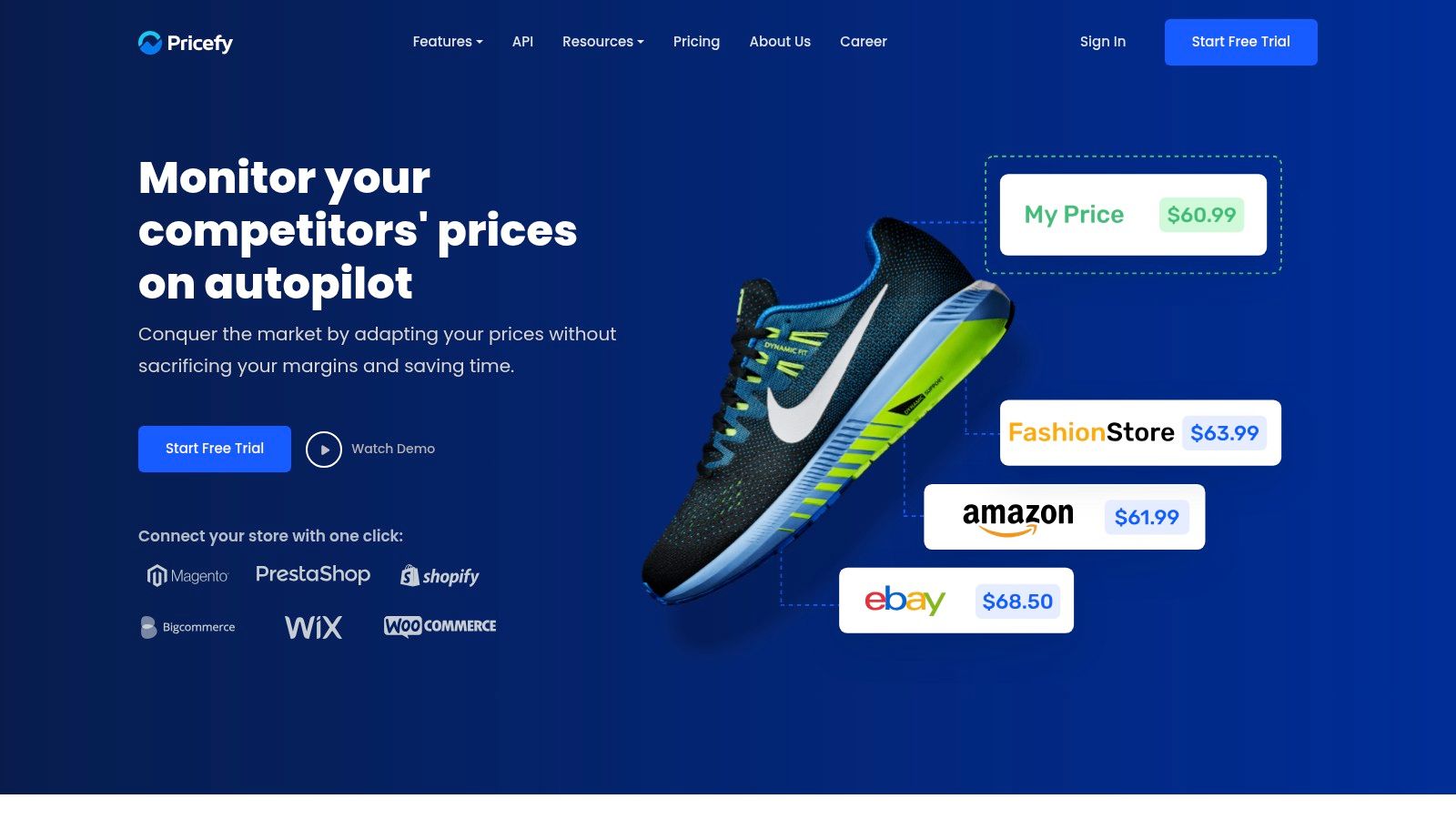
Pricefy positions itself as an approachable competitor price tracking software designed for small to medium-sized businesses. Its core value proposition is simplicity and automation, offering a streamlined onboarding process and features that reduce manual work. The platform emphasizes its AI-powered product matching, which automatically finds competitor listings for a user's catalog, helping teams get up and running quickly without extensive configuration.
The software provides a balanced feature set for businesses looking to automate their pricing strategy without overwhelming complexity. It covers daily monitoring across different countries and currencies, with alerts delivered via email or Slack to keep teams informed. Its dynamic repricing can be set to either fully automatic or semi-automatic, requiring manual approval before price changes go live.
Key Features & Use Case
Pricefy is ideal for e-commerce stores with smaller catalogs that need an easy-to-implement solution. A common use case is a Shopify store owner using the free trial to test the AI auto-match feature on 50 key products. They can then set up dynamic repricing with a manual approval workflow to maintain control while ensuring their prices stay competitive on marketplaces like Amazon and eBay.
Monitoring Frequency: Daily checks with instant, daily, or weekly alerts.
Coverage: Monitors standard websites and major marketplaces like Amazon and eBay.
AI Auto-Match: Automatically discovers and matches competitor products to your catalog.
Dynamic Repricing: Rule-based repricing with fully automatic or semi-automatic (with approval) modes.
Platform Analysis
Pricefy's main strength is its user-friendliness and transparent entry point, featuring a 50-product free trial that allows for genuine evaluation. Its website clearly compares its features against competitors, helping prospective users make an informed decision. The platform is well-suited for businesses that prioritize ease of use over deep technical customization.
Pros: Very approachable for smaller businesses with a generous free trial; transparent feature comparisons on its site.
Cons: Not suitable for tracking complex dynamic variants loaded via AJAX; advanced variant tracking may require unique URLs for each product version.
Website: https://www.pricefy.io
Top 12 Competitor Price-Tracking Tools Comparison
Product | Core features | Anti-bot & data accuracy | Integration & UX | Target audience & scale | Pricing & value |
|---|---|---|---|---|---|
ScrapeUnblocker | Real-browser JS rendering, rotating residential proxies, raw HTML or JSON, city-level geotargeting, unlimited concurrency | High — human-like requests, captcha evasion, accuracy guarantee & quality support | API, docs, sandbox, priority support; fast integration | Dev teams, data/AI projects, large-scale scraping | Simple per-request pricing, predictable costs, positioned lower-cost |
Price2Spy | Competitor tracking, dynamic repricing, 25+ reports | Handles bot-protected & login sites | API + Shopify/BigCommerce/Magento integrations; self-service + pro services | Retailers & brands, marketplace coverage | Transparent plans, 14-day trial; costs can rise with scale |
Prisync | Price monitoring, MAP tracking, dynamic pricing, Shopify app | Standard scraping cadence (URL/channel modes) | Shopify app, clear pricing pages; API (+20% extra) | SMBs to mid-market, Shopify merchants | Clear plans, 14-day trial; some features behind higher tiers |
Wiser Solutions | Enterprise price intelligence, promo & stock tracking, Live Prices API | Proven at scale; near real-time updates | Dashboards, SSO, role-based access, Chrome extension | Large enterprises needing governance & scale | Sales-led pricing; no public rates |
DataWeave | AI pricing intelligence, modeling, advanced product matching | Enterprise SLAs; broad market coverage | APIs, near real-time analytics, enterprise materials | Enterprise retailers/brands with complex needs | Demo/quote model; pricing not public |
Intelligence Node | Patented product matching, very fast refresh rates, SKU dashboards | SLA-backed accuracy (high freshness & matching) | Plug-and-play APIs, dashboards | Large retailers/brands needing strict SLAs | Custom enterprise pricing; example modules costly |
Competera | AI-driven matching, price recommendations, what-if simulations | SLA options; real-time market data | Combined data + optimization workspace, API | Teams wanting integrated pricing decisions & simulations | Enterprise sales process; no public pricing |
Omnia Retail | Multi-domain monitoring, pricing strategy automation, flexible schedules | Flexible crawling; supports whitelisting/blacklisting | Integrations (Shopify etc.), automation engine | Complex multi-domain retailers & brands | Demo-only; sales-led onboarding |
Minderest | Price/promo/stock monitoring, MAP enforcement, screenshot evidence | AI matching, daily tracking, strong QC | API, BI integrations, InSite browser extension | Retailers/brands focused on compliance & quality | Quote/demo model; pricing not public |
Skuuudle | End-to-end product matching, continuous QA, managed reporting | Managed QA with signed-off accuracy | Dashboards, KPIs, managed service delivery | Buyers who want managed engagements & clear QC | Transparent enterprise budgets; demo flow |
BlackCurve | Competitor discovery (Google Shopping), dynamic pricing engine, native apps | Daily multi-run updates; direct site scraping | Native Shopify/Magento/BigCommerce plugins, APIs | Ecommerce merchants using mainstream platforms | Entry & pro plans; trial availability; verify pricing |
Pricefy | Daily monitoring, AI auto-match, dynamic repricing, alerts | Daily/instant modes; limited AJAX/variant support | Quick setup, email/Slack alerts, 50-product free trial | SMBs with small catalogs, quick onboarding | Free trial available; transparent feature comparisons |
Making Your Final Decision: From Data to Dynamic Pricing
Navigating the landscape of competitor price tracking software can feel overwhelming. We've explored a wide array of tools, from comprehensive enterprise platforms like Wiser and Competera to more accessible, SMB-focused solutions like Prisync and Pricefy. Each offers a unique blend of features, integrations, and pricing models designed to serve different business needs. The core takeaway is clear: in today's fiercely competitive digital marketplace, manual price checking is no longer a viable strategy. The speed, accuracy, and scale of automated monitoring are essential for survival and growth.
The central decision you face is not simply which tool to choose, but what kind of solution best aligns with your strategic goals, technical capabilities, and business scale. The right choice will transform raw pricing data from a simple metric into a dynamic, revenue-driving asset.
Recapping Your Options: The Three Tiers of Pricing Intelligence
To simplify your final evaluation, consider the tools we’ve discussed as falling into three primary categories, each serving a distinct purpose and user profile:
Plug-and-Play Solutions (For SMBs and E-commerce Startups): Tools like Prisync, Pricefy, and Skuuudle are excellent starting points. They are designed for ease of use, often featuring direct integrations with platforms like Shopify and Magento. Their strength lies in providing essential features like price monitoring, basic repricing rules, and straightforward dashboards without requiring a dedicated data team. If your primary goal is to quickly gain visibility into your immediate competitors and automate basic pricing adjustments, this category offers the fastest path to value.
Enterprise-Grade Platforms (For Large Retailers and Brands): For large-scale operations, platforms such as Wiser Solutions, Intelligence Node, DataWeave, and Competera provide an all-in-one suite. These solutions go far beyond simple price tracking, incorporating advanced AI-driven analytics, demand forecasting, stock availability monitoring, and assortment intelligence. They come with robust service-level agreements (SLAs), dedicated account management, and the ability to process massive volumes of data across global marketplaces. Choose this path if you need a holistic retail intelligence partner to inform high-stakes strategic decisions.
Foundational Data Infrastructure (For Technically-Savvy Teams): This is where a service like ScrapeUnblocker carves out its unique and critical role. It is not a competitor price tracking software in the traditional sense; it is the engine that powers custom pricing strategies. If your team has the engineering talent but wants to offload the immense challenge of web scraping at scale, this is your solution. It handles the "dirty work" of data extraction, managing proxies, bypassing anti-bot systems, and rendering JavaScript-heavy pages. This provides your data scientists and analysts with a clean, reliable, and continuous stream of pricing data from any website imaginable, ready to be fed into your own proprietary pricing models, BI tools, or AI algorithms.
Actionable Steps to Your Final Selection
Choosing the right path requires honest self-assessment. Before you sign a contract or integrate an API, work through these critical questions with your team:
What is our primary goal? Are we looking to react to competitor price changes, or do we want to proactively set market-leading prices based on demand, stock levels, and perceived value?
What are our technical resources? Do we have developers and data analysts who can build and maintain a custom solution, or do we need a turnkey platform with full support?
What is our required scale and scope? How many SKUs and competitors do we need to track? Are we monitoring a few key marketplaces or a vast array of global e-commerce sites, direct-to-consumer stores, and aggregators?
How important is data flexibility? Do we need pre-built dashboards and reports, or do we require raw, unstructured data to fuel our own unique analytics and machine learning models?
Answering these questions will guide you to the right category. From there, you can run trials, request demos, and compare the specific features of the top two or three candidates within that tier.
Ultimately, investing in competitor price tracking software is an investment in your business's agility and intelligence. Whether you opt for an off-the-shelf platform or build a bespoke system on top of a powerful scraping infrastructure, you are equipping your team with the data needed to make smarter, faster, and more profitable decisions. The era of static pricing is over; the future belongs to those who can master the flow of data and turn insight into action.


Comments