
A Guide to Using a High Anonymity Proxy Server for Web Scraping
- Feb 12
- 15 min read
When you hear the term high anonymity proxy server, you might also hear it called an elite proxy. They're one and the same: a server that acts as the ultimate digital disguise for your online activities. It doesn’t just hide your real IP address; it meticulously erases any evidence that you're using a proxy at all.
For a web scraper, this means its requests look like they're coming from a regular, everyday user, providing the highest possible level of stealth.
The Ultimate Cloak for Your Web Scraper

Think of proxies as different levels of disguise. A basic proxy is like a cheap plastic mask—it hides your face, but everyone can tell you're wearing a costume. A high anonymity proxy, on the other hand, is a complete transformation. It doesn't just swap your scraper's IP address; it actively scrubs the digital fingerprints that give the game away.
Here’s how it works. When your scraper sends a request, an elite proxy intercepts it and strips out specific HTTP headers—most notably and . These headers are the tell-tale signs that a proxy is in use. By removing them, the target website only sees a clean request coming from the proxy's IP. To the website, it looks like completely organic user traffic.
Why This Level of Anonymity Matters
For any serious data gathering operation, this level of concealment isn't just a nice-to-have; it's absolutely essential. Modern anti-bot systems are designed to spot and block basic proxies in a heartbeat. Elite proxies are the key to staying under the radar.
Bypassing IP Blocks: They stop websites from ever discovering—and blacklisting—your scraper's true IP address.
Accessing Geo-Restricted Data: Need to see what users in another country see? An elite proxy from that region makes it possible to gather localized pricing, product stock, and search results.
Maintaining Operational Integrity: When you're running a massive project, like training an AI model or conducting large-scale market research, you can't afford to have your data stream cut off.
The growing reliance on this technology is clear from market trends. The global proxy server market, valued at USD 3.2 billion, is projected to more than double, reaching USD 7.5 billion by 2033. This surge underscores just how critical proxies have become for modern data operations.
A high anonymity proxy is the foundational layer for resilient web scraping. It ensures your scraper can operate undetected, which is the first and most critical step toward gathering accurate, reliable data at scale.
To truly understand why elite proxies are the gold standard, it helps to see how they stack up against other types. Less sophisticated options, like transparent proxies, offer almost no privacy and are trivial for servers to detect. You can learn more about these more basic intermediaries in our guide to transparent proxy servers.
Proxy Anonymity Levels at a Glance
This table breaks down the core differences between the main proxy types, showing just how much your visibility changes depending on the solution you choose.
Proxy Type | Your IP Address Visibility | Proxy Usage Visibility | Best Use Case |
|---|---|---|---|
Transparent | Visible | Visible (HTTP headers reveal proxy) | Caching, content filtering (not for privacy) |
Anonymous | Hidden | Visible (HTTP headers reveal proxy) | Basic privacy, bypassing simple restrictions |
High Anonymity (Elite) | Hidden | Hidden (No proxy headers sent) | Web scraping, security, accessing geo-blocked content |
As you can see, only high anonymity proxies manage to hide both your original IP and the fact that a proxy is being used. This two-part concealment is what makes them so powerful and necessary for demanding tasks like web scraping.
The Spectrum of Proxy Anonymity
Not all proxies are created equal. Think of them like different disguises, ranging from a cheap, see-through mask to a full-on Hollywood-level prosthetic that changes your entire identity. Picking the wrong one for your web scraper is a surefire way to get your IP address blocked before you even get started.
What really separates these proxies is how they handle your HTTP headers. These are little bits of metadata that tag along with every request your scraper sends. Some of these headers are basically digital ID cards, broadcasting who you are and where you're coming from.
Level 3: The Transparent Proxy
First up, we have the transparent proxy. Honestly, calling it a disguise is a stretch; it's more like a detour sign. These are typically used inside company or school networks for things like filtering content or caching data, not for hiding.
A transparent proxy makes zero effort to conceal your identity. It flat-out tells the website you’re visiting your real IP address and admits it’s a proxy. It does this by sending two specific headers:
: This header contains your actual, real-deal IP address. No hiding here.
: This one announces that the request is coming through a proxy.
For web scraping, this is completely useless. It's like walking into a bank with a transparent mask on and a sign that says, "I'm here to scrape." Any site with even the most basic security will spot this immediately and shut you down.
Level 2: The Anonymous Proxy
Moving up the ladder, we find the anonymous proxy. This type offers a bit more privacy by not revealing your original IP address in the header. That’s a decent step up from its transparent cousin.
But it leaves behind a massive clue.
An anonymous proxy still sends the header. So while the server doesn’t know your specific IP, it absolutely knows you're using a proxy.
This is a dead giveaway. Many modern websites are smart enough to flag or block any traffic they identify as coming from a proxy network. It’s like wearing a good mask but shouting, "Hey everyone, I'm wearing a mask!" The element of surprise is gone, and you’re far more likely to get hit with a CAPTCHA or a block.
Level 1: The High Anonymity Proxy Server
Finally, we arrive at the top tier: the high anonymity proxy server, often called an elite proxy. This is the gold standard for serious web scraping because it’s a master of disguise, leaving almost no evidence that a proxy is even involved.
An elite proxy is engineered to make your scraper’s requests look exactly like they came from a regular user. It does this by meticulously cleaning up the HTTP headers, wiping away any digital fingerprints.
Header | Transparent Proxy | Anonymous Proxy | High Anonymity Proxy |
|---|---|---|---|
Reveals your real IP | Removed or altered | Removed | |
Reveals proxy usage | Reveals proxy usage | Removed |
By scrubbing both the and headers, a high anonymity proxy sends a clean, natural-looking request. The target server only sees the proxy's IP address and has no reason to suspect an intermediary. For bypassing sophisticated anti-scraping systems, this level of stealth isn't just nice to have—it's essential for keeping your data collection running smoothly.
How High Anonymity Proxies Evade Detection
Think of a high anonymity proxy server as a digital "clean room" for your scraper's web requests. It doesn't just slap a new IP address on your request and send it on its way. Instead, it meticulously rebuilds the request from the ground up, scrubbing away any digital breadcrumbs that could point back to you or even whisper that a proxy is involved. This is a much deeper process than simply masking your IP.
To really get why this matters, you have to understand what you're up against. Modern websites use some seriously clever techniques to spot and block automated traffic. They're not just glancing at an IP address anymore; they're analyzing the entire digital signature of every incoming request, hunting for the tiniest inconsistencies that scream "bot!"
This infographic really captures the journey from a totally obvious transparent proxy to a completely hidden elite proxy.
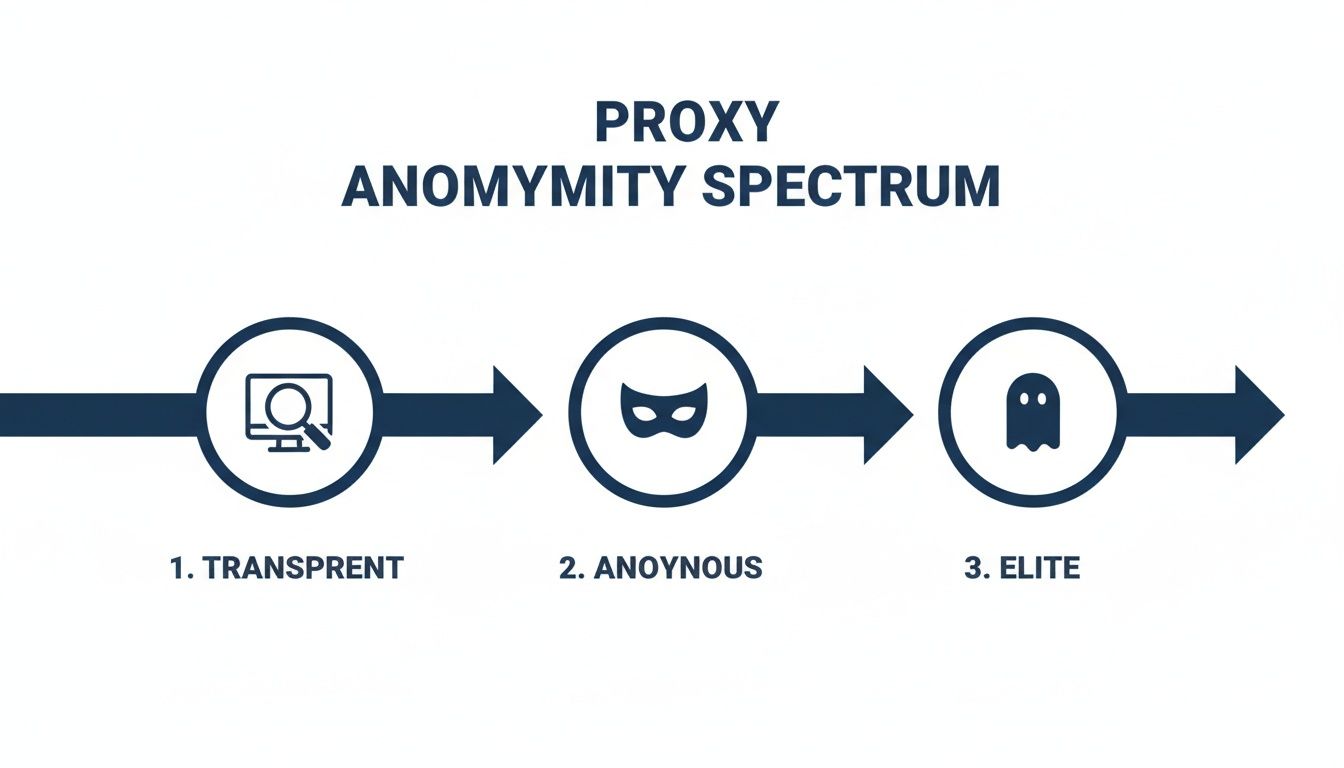
As you can see, you only achieve real anonymity when both your original IP and the proxy's presence are hidden. That’s the gold standard of an elite system.
Winning the Header Inspection Game
One of the first lines of defense for any website is scrutinizing HTTP headers. As we've touched on, headers like and are dead giveaways that a proxy is being used. A high anonymity proxy makes sure these are completely stripped out before the request ever hits the target server.
But the smarter anti-bot systems dig deeper. They look for subtle mismatches between different headers. For instance, your request might have a User-Agent header claiming it's from a Chrome browser on a Mac, but other headers might contain values typically found on a Linux server. Those tiny discrepancies are huge red flags.
A true elite proxy service intelligently manages and normalizes all these headers to present a cohesive, believable profile. It ensures every piece of the puzzle fits, creating a consistent identity that looks exactly like a real user's browser.
Defeating IP Reputation Analysis
Here’s a hard truth: not all IP addresses are created equal. Websites maintain and subscribe to massive blacklists of IPs known to belong to data centers, public proxies, or other shady neighborhoods. If your request comes from an IP on one of those lists, it’s often blocked on the spot, no matter how perfect its headers are.
This is where the difference between datacenter and residential IPs becomes so important.
Datacenter IPs: These come from commercial servers. They're fast and affordable, but they are also incredibly easy for websites to identify as non-residential, making them an easy target for blocking.
Residential IPs: These are the real-deal IP addresses assigned by Internet Service Providers (ISPs) to actual homes. From a website's perspective, they are indistinguishable from genuine user traffic, giving them a spotless reputation.
A high anonymity proxy backed by a large pool of residential IPs is the most powerful combination you can get. The proxy scrubs the request clean, and the residential IP provides the trustworthy origin that sails right past reputation checks.
For any serious web scraping operation, using a service with a diverse and clean pool of IPs is non-negotiable. This often means learning how to swap IPs strategically to avoid drawing attention. You can dive deeper into these methods in our complete guide to rotating proxies for web scraping.
Mitigating Behavioral and Fingerprinting Analysis
The most advanced anti-bot systems have moved beyond simple checks. They now use behavioral analysis and browser fingerprinting to spot patterns that are incredibly difficult for basic scripts to fake.
These systems are watching for things like:
Request Rate: Is this IP making requests faster than any human possibly could?
Navigation Patterns: Did the visitor jump directly to a deep product page without ever hitting the homepage or a category page first? Real users don't do that.
Browser Fingerprint: This is a unique signature created from details like screen resolution, installed fonts, browser plugins, and even how your GPU renders graphics.
A high anonymity proxy, on its own, can't solve these challenges. However, top-tier services like ScrapeUnblocker don't just give you a proxy; they integrate it into a much larger infrastructure designed to mimic human behavior. By managing things like cookies, JavaScript execution, and even using real browser instances, these systems can defeat the most rigorous fingerprinting and behavioral checks, ensuring your proxy's powerful anonymity doesn't go to waste.
What This Means for Your Web Scraping Projects
Knowing the tech behind high anonymity proxies is great, but what really matters is how it helps you get the job done. For anyone scraping the web, better anonymity directly translates to better data, fewer headaches, and a much cleaner workflow. The whole point is to make your scraper look like just another person browsing the internet.
When your scraper's requests blend in with regular human traffic, you sidestep the most common roadblocks that derail data collection projects. This is where you gain real advantages that are simply out of reach with basic proxies.
Get Past Geo-Fences and See Local Content
Let's say you need to track product prices in different countries. A website almost always serves content based on the location of your IP address. A high anonymity proxy with geo-targeting is like a digital passport, letting your scraper show up as if it's coming from London, Tokyo, or anywhere else you need.
This is a game-changer for a few key tasks:
E-commerce Price Monitoring: You can pull accurate pricing from regional online stores to see what competitors are really charging.
SERP Analysis: It allows you to check how search results for the same keyword differ from one city or country to another.
Ad Verification: You can confirm that digital ads are actually running in the specific regions they're supposed to be targeting.
By routing your scraper's traffic through a residential IP in Germany, for instance, you see the exact same content a German user would. The data you collect is genuinely local and, therefore, far more valuable.
Sidestep IP Bans and CAPTCHA Walls
The number one killer of any web scraping operation? Getting blocked. Websites deploy sophisticated anti-bot systems designed to spot and blacklist IPs that behave like a script. High anonymity proxies are your best defense.
By completely masking your scraper's true origin and making its activity look human, elite proxies dramatically lower your chances of hitting an IP ban or a CAPTCHA puzzle that stops your data pipeline cold.
This reliability is everything. The demand for proxies that can consistently evade detection is a key reason the proxy network software market is projected to hit $5.8 billion by 2033. Businesses need tools that work. You can find more details about this growing market on StrategicRevenueInsights.com.
Run Large-Scale Scraping Jobs at the Same Time
Scaling up from a few hundred requests to millions is a huge leap. You need an infrastructure that can handle that volume without setting off every alarm. A big pool of high-anonymity residential proxies lets you spread your requests across thousands of different IP addresses. This strategy avoids the classic bot-like pattern of one IP making way too many requests too quickly.
This distribution is what enables massive concurrency—the ability to run countless scraping tasks in parallel and gather data at an incredible speed. Of course, getting the data is only half the battle. You also need to process it. For example, if you're pulling down reports or whitepapers, having a good guide on how to extract PDF data is essential for getting the information out of those files and into a usable format. In the end, it all comes down to getting better results, faster.
Best Practices for Implementing Anonymity
Just having a high-anonymity proxy is only half the story. Think of it like being handed the keys to a stealth fighter jet—its effectiveness boils down to the pilot's skill. How you actually manage your scraping operations is what separates success from a pile of blocked requests.
To truly fly under the radar, you need a solid game plan. This goes way beyond just swapping out your IP address; it’s about creating a holistic strategy that mimics real human behavior from top to bottom.
Master Intelligent IP Rotation
One of the most common rookie mistakes is rotating IPs too quickly or predictably. If you send one request from a New York IP, the next from Los Angeles, and a third from London all within a few seconds, you’ve set off every alarm bell. No human teleports that fast.
This is where intelligent IP rotation comes in. The goal is to group your proxies by location and stick with one IP for a whole session before moving on. This looks much more like a real person browsing a site for a few minutes.
Session-Based Rotation: Assign one proxy IP to a user "session." Let it browse a few pages, maybe click a link, and then cycle to a new IP for the next session.
Geo-Targeted Rotation: Scraping local data? Stick to proxies from that specific country or city. It keeps your digital identity consistent and believable.
Randomized Intervals: Don't rotate IPs on a strict timer. Throw in some random delays between rotations to break up any robotic patterns.
Diversify Your Digital Identity
Websites aren't just looking at your IP address; they're also checking your User-Agent. This is a simple HTTP header that tells the server what browser and operating system you’re on. Sending thousands of requests from the exact same User-Agent is a dead giveaway.
A smarter approach is to maintain a big list of current, real-world User-Agent strings and cycle through them. You want your requests to look like they’re coming from a crowd of different people using different devices.
Your scraper should look like a crowd, not a clone army. By diversifying User-Agents, you spread out your digital footprint, making it incredibly difficult for anti-bot systems to spot a single, repetitive source.
This strategy is especially effective in the North American market, which has a massive pool of roughly 19 million residential IPs. The U.S. alone makes up over 11 million of them, fueling a market valued at USD 122.03 million that continues to grow. This huge IP supply allows services to blend in with real human traffic at scale, getting past blocks on even the most fortified websites. You can find more details in the residential proxy server market report from Mordor Intelligence.
Manage Cookies and Sessions Like a Pro
Here’s a simple truth: real users have cookies. These little files help websites remember login info, what’s in a shopping cart, and other preferences to create a smooth session. A scraper that rejects every cookie or never sends any stands out like a sore thumb.
Proper cookie management is a must for any modern, dynamic website. Your scraper needs to be able to:
Accept and Store Cookies: Grab cookies from a site’s response headers.
Send Cookies Back: On your next request to that same domain, include the cookies you stored.
Isolate Cookie Jars: Never mix cookies between different proxy sessions. This prevents you from accidentally linking your different digital identities together.
Handling sessions this way makes your scraper look like a returning visitor instead of a brand-new bot on every request. It’s a game-changer for navigating sites with logins or multi-step checkout processes.
Defeat Advanced Browser Fingerprinting
The final boss of bot detection is browser fingerprinting. This is a sophisticated technique that builds a unique profile of each visitor by collecting tons of subtle data points from their browser, like:
Screen resolution
Installed fonts
Browser plugins
Timezone
Canvas and WebGL rendering details
A high-anonymity proxy can't hide any of this on its own. This is where you need a service that uses real, headless browsers. These tools render web pages just like a normal Chrome or Firefox browser would, creating a legitimate and consistent fingerprint for every request.
When you pair a clean residential IP with a real browser instance, you’re presenting a complete, believable identity that can bypass even the most aggressive security measures. Adopting these practices turns your proxy from a simple disguise into full-blown digital camouflage.
How a Scraping API Simplifies Anonymity
Let's be honest: juggling a fleet of elite proxies, constantly rotating IPs, tweaking headers, and trying to act human is a massive headache. It can easily spiral into a full-time job, pulling you away from the actual goal of getting data. This is where a good scraping API completely changes the game.
These services essentially handle all the messy, technical details for you. Instead of building a complex system from scratch, you just make a straightforward API call and let the service do the heavy lifting.
The Power of Abstraction
A great way to think about it is ordering food from a restaurant versus cooking a gourmet meal yourself. When you use a scraping API, you're just telling the chef what you want (the data from a specific URL). They take care of all the complex kitchen work behind the scenes.
Proxy Management: The API automatically picks the best residential proxy for the job and rotates it as needed. No more manual selection or IP blacklists.
Browser Fingerprinting: It spins up real browser instances, complete with authentic fingerprints, to slip past even the most advanced bot detectors.
CAPTCHA Solving: If a CAPTCHA pops up, the service solves it instantly without you ever knowing it was there.
This approach lets your team get out of the business of managing infrastructure and back to focusing on what matters: analyzing the data you collect. For developers, this is a huge win. You can dig deeper into choosing the right tool in our guide to the 12 best web scraping API options for 2025.
From Complex Code to a Simple Call
Imagine swapping hundreds of lines of code for session management, cookie handling, and retry logic for just one clean request. That's the reality with a scraping API. It takes your target URL and gives you back structured data, often in JSON, ready to use right away.
By consolidating rendering, proxy management, and block evasion into one API, services like ScrapeUnblocker reduce operational overhead and accelerate the time it takes to get value from your data.
Remember, a solid anonymity strategy goes beyond just proxies. Following established REST API security best practices is crucial for protecting the data you handle and keeping your operations under the radar. It secures the entire pipeline, from the initial request to the final dataset.
Frequently Asked Questions
Jumping into the world of proxies can feel a bit like alphabet soup, with terms like "elite," "VPN," and "residential" thrown around. Let's clear up some of the most common questions people have when trying to choose the right tool for the job.
High Anonymity Proxy Versus VPN
So, what’s the real difference between a high anonymity proxy and a VPN? They both hide your IP, but that's where the similarities end. They operate on totally different scales and are built for different tasks.
A high anonymity proxy server is an application-level tool. You can set it up to work directly with your web scraper, which gives you the power to juggle hundreds, or even thousands, of distinct online identities simultaneously. It's the go-to for large-scale data gathering.
A VPN, in contrast, works at the device level. When you turn on a VPN, it encrypts and reroutes all the traffic from your computer or phone through a single server. This is fantastic for personal privacy and security, but it just doesn't offer the flexibility or scale you need for serious web scraping.
Can Websites Still Detect Scrapers Using Elite Proxies
If I'm using a top-tier elite proxy, can websites still figure out I'm a scraper? Absolutely. An elite proxy is a master at hiding your IP address and the fact that you're using a proxy, but that’s only one part of the equation.
An elite proxy is a master of disguise for your IP, but it can't change your scraper's fundamental behavior. Advanced anti-bot systems look for more than just IP data.
Modern websites are smart. They look beyond your IP and use sophisticated detection techniques, including:
Browser Fingerprinting: They analyze the unique digital signature of your browser—things like screen resolution, installed fonts, and plugins—to build a profile.
Behavioral Analysis: They watch how you interact. Are you clicking through pages too fast? Is there no mouse movement? These robotic patterns are dead giveaways.
This is exactly why a complete scraping API solution is often more effective. It doesn't just provide elite proxies; it also intelligently manages headers, cookies, and even mimics human-like browsing behavior to build a truly convincing user profile.
Residential Proxies Versus Datacenter Proxies
When it comes to high anonymity, which is better: residential or datacenter proxies? Hands down, residential proxies are the undisputed champions for blending in.
The secret is their source. Residential IPs come from actual Internet Service Providers (ISPs) and are tied to real home internet connections. To a website's server, traffic coming from a residential IP looks exactly like traffic from an ordinary person browsing from their living room.
Datacenter IPs, on the other hand, are born in a server farm. They're fast and cheap, but they come from commercial data centers. Anti-bot systems can spot entire ranges of these IPs and block them outright. If you're scraping a heavily protected site where staying under the radar is everything, residential proxies give you a level of authenticity and stealth that datacenter proxies just can't match.
Comments